Nature · San Bartolomé de Tirajana
Dunes of Maspalomas
Desert by the Atlantic: Hiking, marveling, and rules in the nature reserve - Golden waves of sand, a lagoon, and a palm grove right next to the hotels: The Dunes of Maspalomas are the island's most famous natural wonder. However, they are a strictly protected area that may only be entered on marked paths.

On the southern edge of Gran Canaria stretches a small desert that seems almost surreal between hotels, beach, and sea. The dunes of Maspalomas are among the most impressive landscapes in the Canary Islands and are a must-see for many holidaymakers.
The essentials
The area is protected as a Reserva Natural Especial and covers around 400 hectares. It is approximately six kilometers long and one to two kilometers wide, stretching between Playa del Inglés and Meloneras. The dunes are up to about ten meters high. The fine sand consists of ground coral and shell limestone. It is moved by the wind, so the dunes are constantly changing. In addition to the dune field, the reserve includes the palm grove (Palmeral), the lagoon Charca de Maspalomas , and the beach.
The dunes may only be entered on the designated paths. Anyone who leaves the paths or crosses the dunes away from them risks a fine, which starts at 150 euros . This is not an empty threat: the municipality and the Guardia Civil have increased controls in recent years, and violations are regularly penalized in the reserve. The dunes are now monitored by rangers and, as we know, also with drones. It remains a nature reserve.
Further rules from the reserve's code of conduct:
- Stay on the marked paths, also for your own safety.
- Don't build stone structures or shelters from plants, this disrupts the dynamics of the dunes.
- Don't feed animals and take your rubbish with you.
- Avoid unnecessary noise.
- Nudism is only permitted in designated beach areas outside the reserve.
- The visitor center (Centro de Interpretación) is free to access.
Walk: From the dunes to the beach
The ideal starting point for a walk is the Hotel Riu Palace Maspalomas on Avenida de Tirajana. From there, a marked path leads through the dunes to the beach. The route is approximately 1.5 kilometers long and takes around 30 minutes. You come out directly at the legendary Kiosk No. 5 (formerly No. 7) on the beach, the well-known gay beach of Maspalomas. The kiosk is popular for drinks and snacks. If you continue west, you'll reach the lighthouse.
If you want to see the entire dune field, plan about an hour for the route between the lighthouse and Playa del Inglés, longer with breaks. Walk barefoot if you like, as the sand is soft, but take shoes with you as it can get very hot at midday.
What to discover
- Dune landscape: Wave-shaped sand ridges reminiscent of the Sahara. From the top of the higher ridges, you have views all the way to the sea.
- Charca de Maspalomas: A brackish lagoon located about 200 meters from the lighthouse. It is a resting place for migratory birds such as herons, ducks, and wading birds. You can observe it from the edge; binoculars are worthwhile.
- Palmeral de Maspalomas: A palm grove on the northern edge of the reserve with welcome shade.
- Faro de Maspalomas: The lighthouse from 1890 is around 56 meters high and is the landmark of the area. Around it, there is the promenade, restaurants, and shops of Meloneras.
- Wildlife: Giant lizards and many seabirds live in the dunes and around the lagoon.
- Camel ride: A half-hour tour on a dromedary takes you through the dunes. The camels depart from the tents at the edge of Barranco de Fataga, just a few hundred meters from the lagoon. The tour is popular, so check with operators beforehand about prices and conditions.
- Sunset: Watching the sunset over the lagoon and Atlantic from a higher dune is one of the most beautiful natural experiences in the south.
Getting there
- By bus: The main stop is "Faro de Maspalomas". Several Guaguas Global lines stop there, such as lines 1, 30, and 50. From there it's just a few steps to the beach and dunes.
- On foot: The dunes are easily accessible from Playa del Inglés and Maspalomas, along the promenade or via the marked paths.
- Access points: There are several access points, for example at Hotel Riu Palace, at the lighthouse, and from the Palmeral side.
Practical tips
- Sun and wind: There's hardly any shade in the dune field. Bring sun protection, a hat, and plenty of water.
- Best time: Early in the morning or late afternoon, when it's cooler and the light shows off the dunes particularly well.
- Accessibility: Direct access to the dunes is not suitable for people with limited mobility. At the lighthouse there's a wide promenade from which you can see the dunes and lagoon.
- Respect: The area is sensitive. No litter, no shortcuts, no photos of people without permission, especially at the nudist beach.
Our tip
Start at Riu Palace, walk about 30 minutes to the kiosk on the beach, treat yourself to a drink there, then walk along the beach to the lighthouse or back. With a bit more time, a visit in the late afternoon is worthwhile—you can experience the sunset on your way back.
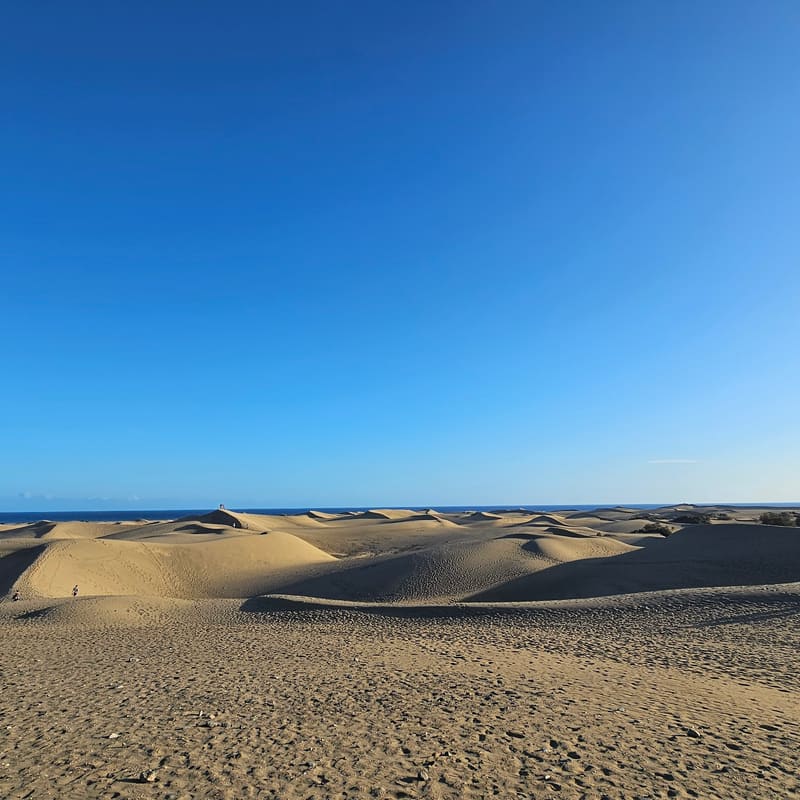
Foto: Tom 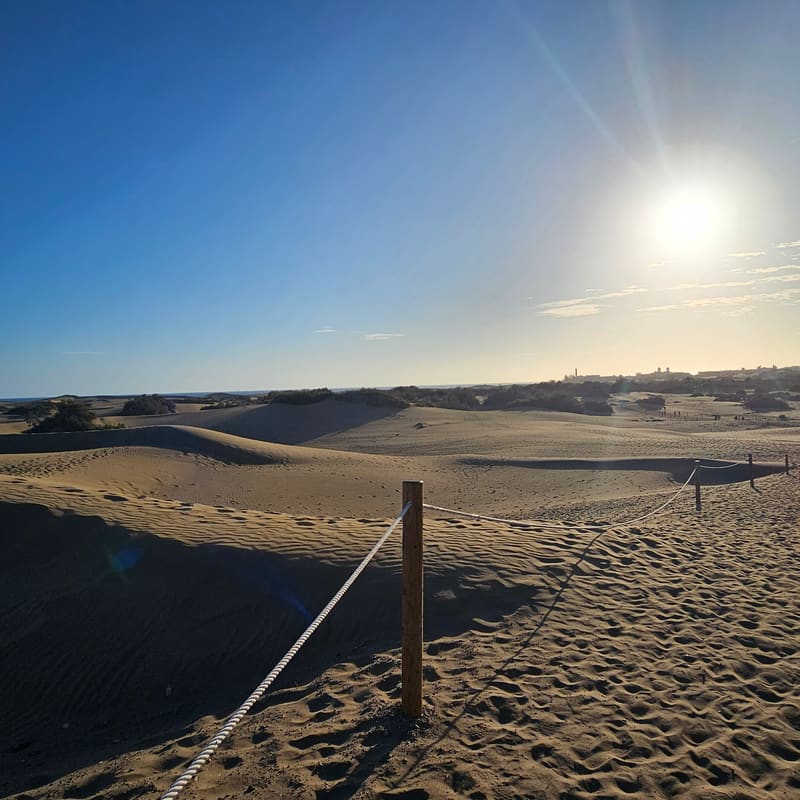
Foto: Tom 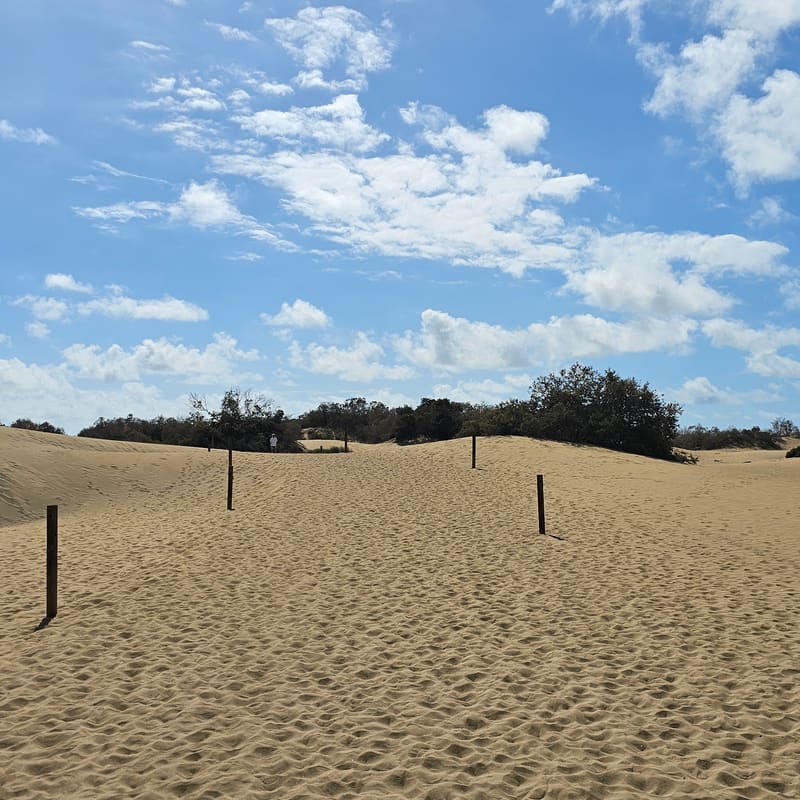
Foto: Tom 
Foto: Tom


Lage
In der Nähe

Strand
Kiosk No. 5 - Gay Strand Maspalomas
Am Kiosk No. 5 (früher No. 7) hinter den Dünen von Maspalomas liegt der bekannte Gay-Strand der Insel. Entspannte Stimmung, Musik, kühle Getränke und eine Regenbogenflagge machen ihn zum festen Treffpunkt. Wichtig: Zu großen Events früh kommen, sonst gibt es keine Liege.
Strand
Playa de Maspalomas
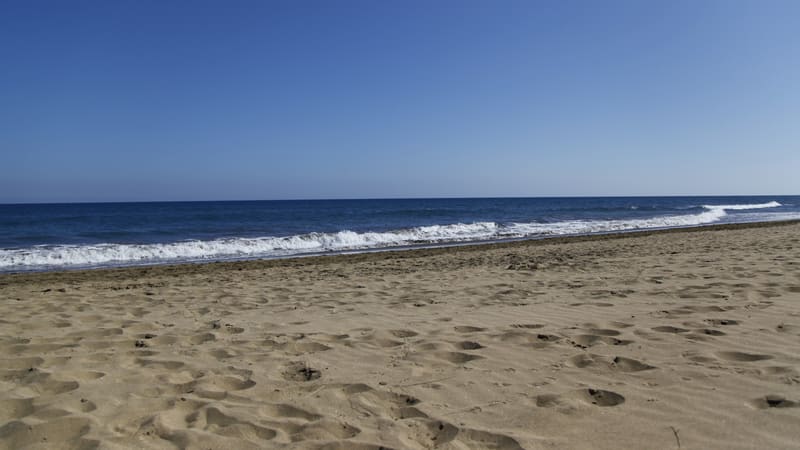
Kilometerlanger goldener Sandstrand, Dünenlandschaft direkt dahinter und von der Promenade bis zum Leuchtturm alles, was ein Strandtag braucht. Hier erfährst du, was dich am Strand von Maspalomas erwartet.
Strand
Playa El Veril
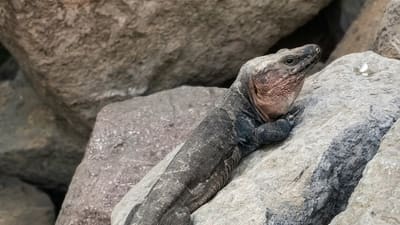
Ruhiger Strand mit goldgelbem Sand zwischen Playa del Inglés und San Agustín. Weniger Trubel als in Playa del Inglés, dafür Platz, ruhiges Wasser und Rieseneidechsen an der Promenade. Der Playa El Veril ist eine entspannte Alternative zu den großen Stränden im Süden.
Aussichtspunkt
Mirador Astronómico de la Degollada de las Yeguas
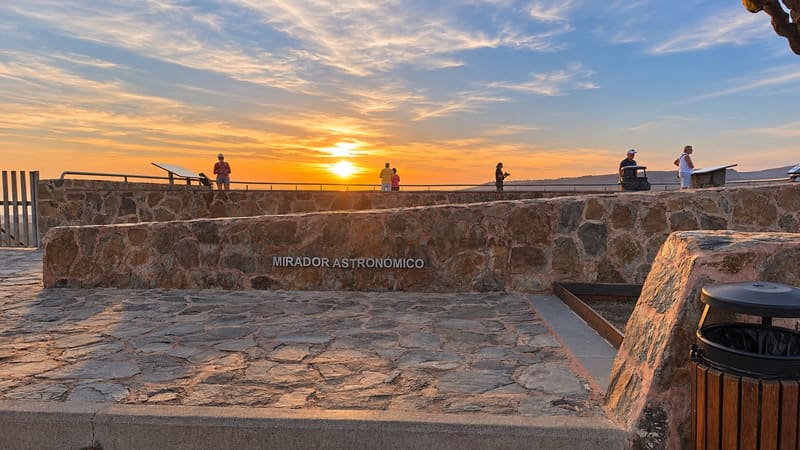
Spektakuläres Panorama zwischen Grand Canyon und Sternenhimmel: Auf 842 Metern Höhe bietet der leicht zugängliche Mirador de la Degollada de las Yeguas einen der atemberaubendsten Ausblicke Gran Canarias. Besucher blicken hier tief in die monumentale Fataga-Schlucht und sehen bei klarer Sicht im Süden das Meer und die Dünen von Maspalomas. Idealer Ort zur Sternenbeobachtung!


Common questions
Where are the Dunes of Maspalomas located?
The Dunes of Maspalomas stretch along the southern edge of Gran Canaria between Playa del Inglés and Meloneras. The nature reserve is about six kilometers long and one to two kilometers wide.
Are you allowed to walk in the dunes of Maspalomas?
In the dunes of Maspalomas, you may only walk on the designated paths. Anyone who leaves the paths or crosses the dunes away from them risks a fine starting at 150 euros.
How do I get to the Dunes of Maspalomas?
You can reach the Dunes of Maspalomas by bus to the stop "Faro de Maspalomas", where several Guaguas Global lines stop, for example lines 1, 30 and 50. From Playa del Inglés and Maspalomas, the dunes are also easily accessible on foot.
When is the best time for the Dunes of Maspalomas?
The best time for the Dunes of Maspalomas is early in the morning or late afternoon, when it's cooler and the light shows off the dunes particularly well.
What can you see at the Dunes of Maspalomas?
At the Dunes of Maspalomas, you can see the wave-like sandy landscape, the brackish water lagoon Charca de Maspalomas with migratory birds, the palm grove Palmeral de Maspalomas, and the 56-meter-high lighthouse Faro de Maspalomas from 1890. Giant lizards and many seabirds also live in the dunes and around the lagoon.